REEL TOP 40 RADIO REPOSITORY

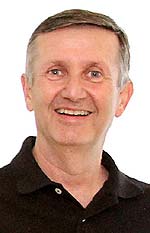
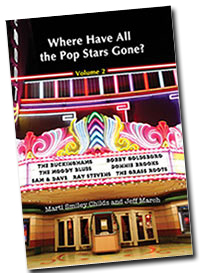
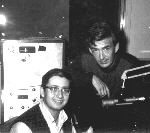
Jeff March, co-author of Echoes of the Sixties and Where Have All The Pop Stars Gone? - Volume 1, and Where Have All The Pop Stars Gone - Volume 2, grew up in Los Angeles during the golden age of Southern California Top 40, and worked in California radio between the mid-1960s and the mid-'70s. While a journalism student studying broadcasting at San Fernando Valley State College (later renamed California State University, Northridge), he got his first commercial radio job in late 1967 as a board operator at Spanish-language KSFV San Fernando (106.3 mHz)--which went dark in the spring of 1968. From there, he joined KVFM San Fernando (94.3 mHz) doing weekend board op shifts and relief before moving to 9:30-midnight weekdays--for $1.60 per hour. In 1969 Jeff moved on to country-formatted KIEV Glendale (870 AM) where the hours and the pay were a lot better. By 1970 he also was running Mutual Network news feeds out of KBBQ Burbank (1500 AM), working with newscasters Charles Arlington and Mark Stacey. After a stint as a recording studio engineer in Hollywood, Jeff moved with his wife Marsha to the Sierra Nevada foothills town of Auburn, where in May 1972 he became program director of KAHI (950 kHz) and KAFI (101.1 mHz), a small-town radio operation. That autumn he moved on to top-40 leader KROY Sacramento (1240 kHz), of which he was production director until early 1974. From that point, with the exception of a couple of brief and largely unsuccessful forays into sales at KNDE (1470 kHz) and KGMS (1380 kHz) in Sacramento, Jeff has worked principally in print communication, encompassing copy writing, advertising management and editorial supervision of news publications. In 1993 he and Marti Smiley Childs — with whom Jeff worked at the University of California, Davis for a decade — formed EditPros, a firm in Davis that provides writing and editing services for businesses, government agencies and research and trade organizations. In 1997 Jeff and Marti began work on their book Echoes of the Sixties, which was published in November 1999 by Billboard Books. 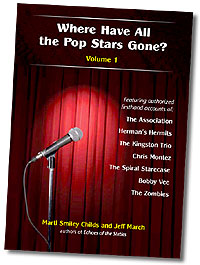
In 2011, Marti and Jeff published Where Have All the Pop Stars Gone? - Volume 1. Old songs are like old friends. But what of the talented people who composed and performed those old favorites? This book chronicles the lives of musical soloists and band members whose songs hit the top of the music charts in the late 1950s and in the '60s.
Chapters on seven musical groups and solo performers are included. Through conversations with performers, producers, managers and family members, the book offers fascinating behind-the-scenes glimpses into the lives of The Association,
They followed that in 2012 with Where Have All The Pop Stars Gone? -- Volume 2, containing chapters about The Buckinghams, Bobby Goldsboro, The Moody Blues, Donnie Brooks, Sam & Dave, Ray Stevens and The Grass Roots. They have begun work on a third volume. EditPros has evolved into book publishing, with a catalog of titles by a half-dozen authors. |

[Descriptions by Jeff March unless indicated]
Smoke several cartons of Winston right now...
|
 TOP STREAM 32 Kbps TOP STREAM 32 Kbps  Tony Bond, WKFR Battle Creek Michigan February 1965 (RESTORED) (59:38)
 This Exhibit 'SCOPED (28:50)
. . . Yes, New York's a lonely town - you oughta try Battle Creek, baby . . . [Description by contributor Jeff March] This is not as much a description of an aircheck as it is a tribute to Graeme A. "Tony" Bond, a longtime friend and college classmate of mine, who died four days after the heart attack he suffered on March 13, 2010, at the age of 71. I was a freshman at San Fernando Valley State College (now California State University, Northridge) when Tony entered the broadcasting program as a senior transfer student. He came with a resume of professional experience, which he had acquired in military public information service and in professional radio, and instantly became a mentor for younger students (including me) at the college FM radio station, KEDC (now KCSN). He brought a real-world perspective to what previously had been a largely academic program. When I expressed interested in Tony's on-air work, he let me dub a copy of this aircheck, which he had recorded in the studio while on the air at WKFR. He was working there on what he called "a lend-lease deal" between the Public Information Office of 6th US Army Corps and the Knorr Group, which included WKFR Battle Creek and WKNR ("Keener Radio") in Detroit. In exchange for Tony pulling down air shifts, WKFR agreed to broadcast 5-minute Army radio recruiting segments on the Knor stations during regular daytime hours, rather than overnight. Tony worked under that arrangement, producing much of the public service material himself, from from about 1962 to '65. "There was a stipulation. I would be hung from a tender part of the body if I caused any negative perceptions regarding the U.S. Army," Tony later wrote in an e-mail message. "It all came out just dandy, Army won, I got $$. Doesn't get any better for a draftee! However, don't remind me of the paperwork to pull it off, all the way through a lieutenant general in 5th Army Division Command, Chicago. Guess they needed a recruiting boost. It was approved in one week. It was fun, fun, fun!" Tony was born in the Schofield Barracks Infirmary (of "From Here to Eternity" fame) in Wahiawa, Oahu, Hawaii. He was the son of Col. Graeme S. Bond, who had been a command pilot (heavy bombardment) with the U.S. Army Air Corps and U.S. Air Force during World War II and Korean War. Tony graduated in 1957 from the high school at Pepperell Air Force Base in in St. John's, Newfoundland, Canada. His father was the commander of the base, which was deactivated and closed in 1960. While in high school Tony landed first job in broadcasting at VOUS, AFRTS, St. John's, in 1956-57. Tony enrolled as a freshman under the ROTC program at Michigan State University, where he played football while working part-time at WKAR-TV and radio in Detroit. In 1959 he transferred to Arizona State University, for which he played football and some baseball while working in the Phoenix radio market, and remained there until he was drafted into military service in 1961. Drawing upon his commercial experience, the Army assigned him as an information and broadcasting specialist in various military public information offices. Following his military discharge, he worked in broadcasting in Santa Barbara, Calif., Los Angeles, Miami and Honolulu. Along the way he spent some time as the ground station manager of the Peacesat Satellite Network. After his graduation from San Fernando Valley State College, Tony completed postgraduate work at Slippery Rock University in Pennsylvania, then joined the faculty of the University of Hawail, at which he eventually became head of radio-TV-film programs. He subsequently taught at the University of Miami and Florida International University. In 2004 Tony and his wife, Annette, relocated to Henderson, Nev., where they lived at the time of his death. Tony was affable, friendly, welcoming, kindhearted, enthusiastic and had a terrific sense of humor. He was an effective leader and a good friend with whom the KEDC guys and I enjoyed going out for pizza and beer, attending sports events, and going on weekend camping trips. Tony didn't try to assume any on-air persona other than his own. You'll hear Tony on this aircheck as he really was, and I will miss him. 
 Return to the Repository
|
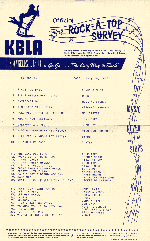
 Tom Clay, KBLA Burbank, 5/15/65 (16:28)
. . . What the world needs now is love, sweet love . . . Our name is Tom Clay. . . Tom Clay was an extraordinary disc jockey and an extraordinary human being. He was extraordinary in the sense that his program did not follow the norm. He did not do the ordinary. He was an exceptional story-teller, and he interspersed the records he spun with tales of the experiences that shaped his life. His program was different. It was dimensional. It was not for everyone. Tom Clay came from the Detroit market, where he'd worked at WJBK. He was in the starting lineup (with Humble Harve, included on this aircheck with a promo for his morning show) of the top 40 format that KBLA Burbank unveiled in February 1965, just a few months before Boss Radio broke big-time in Los Angeles. At the time of this aircheck, Boss Radio was less than two weeks old. Until that time, KBLA operated invisibly on 1490 kHz with 250 watts. Although it was within the Los Angeles metropolitan area, few knew the station existed. Then the station was awarded a construction permit to shift to 1500 kHz with 10 kilowatts days, 1 kilowatt at night and an absolutely abysmal coverage pattern by virtue of its transmitter location—clinging to the side of a barren mountain above Burbank. The signal nulled in the parking lot of the station at 131 E. Magnolia, within view of the towers. Nevertheless, Tom Clay held forth with his "Words and Music" program 4-8 p.m. nightly. The KBLA experiment lasted only two years, but enjoy it at its best on this Tom Clay aircheck.
|
|
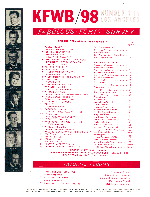
Wink Martindale, KFWB Los Angeles, June 2, 1965 (17:24)
...they want to find these people to be police officers at a starting salary of six hundred and eight dollars a month...
Morning drive man Wink Martindale led off the lineup of the KFWB "Good Guys" who also included Hal Pickens (9 a.m.-noon, one set from Hal is heard at the end of this aircheck), Don MacKinnon (noon-3 p.m., killed in June 1965 in an automobile crash), Gene Weed (3-6 p.m.), B. Mitchel Reed (6-9 p.m., d. 1983), Reb Foster (9-midnight) and Larry McCormick (midnight-6 a.m.). Additionally featured in this half hour (8:30 - 9:00 am, 6/2/65) is long-time L.A. news reporter Beach Rogers; also, a very stylish spot for Winston cigarettes. |
...Do not forsake me, oh my darlin' - on this our weddin' day - I married my old horse, Biscuits - so together we can really hit the hay...
|
|
TOP STREAM 32 Kbps (10Khz)
Coffee Jim Dandy, Mark Lane, KENO, Las Vegas, April 7 1966 (01:04:00)
. . . performing now at the Thunderbird Hotel . . . [Description by contributor Jeff March] This is an aircheck that captures a lively radio station at the top of its game, entertaining a town that returned the favor by routinely giving it astronomical Hooper and Pulse shares in the 30s and 40s. Las Vegas in the spring of 1966, when this aircheck of KENO was recorded, was more of a town than a city. Vegas, which now has an urban population of 1.3 million residents, had only about 90,000 residents in 1966. Back then, the town had only three public high schools, and what is now UNLV was a small campus known as Nevada Southern University (you'll hear a mention of it as "NSU" in this aircheck).The Aladdin Hotel and Casino had opened only six days before the date of this aircheck, and Caesars Palace was still four months from its completion. Later that year, Howard Hughes would take up residence at the Desert Inn, which he subsequently bought. Circus Circus was not yet open, and the MGM Grand would not be completed for seven more years. The bright lights of Vegas in those days were confined to the "Strip" (which extended only as far south as the Hacienda Hotel and Casino -- now the site of the Mandalay Bay Hotel-Casino), along with a short stretch of the Boulder Highway, and Fremont Street in the downtown area. Back then, cars could drive on Fremont all the way to First Street, and the sounds of Radio KENO poured into the warm night air from the windows of nearly every car that cruised down "glitter gulch" past The MInt Casino & Hotel, the Golden Nugget, the Horseshoe Club, the Fremont Hotel & Casino and the El Cortez Hotel & Casino. "Coffee" Jim Dandy, Mark Lane, "Uncle" Bob Martin, Bill Wood Jr., Dave Ambrose, Corky Mayberry, Scott Morgan, Jeff Colson and Jim Blaine — some of the "Radio KENO Good Guys" during that era — were mobbed when they made public appearances in their natty "Color Radio Channel 146" blazer jackets. KENO always had special meaning for me. During my early teenage years in the San Fernando Valley in the northern part of Los Angeles, I enjoyed DX-ing (listening to distant radio stations at night) and requesting QSL (reception verification cards) from radio stations that I picked up. One of those stations was KENO, which invited me to visit the station. My folks vacationed in Vegas a few times each year, and in December 1963 I took KENO up on its offer. The KENO studios and transmitter site were on a sand-blown patch of land a couple of hundred yards northeast of the intersection of Flamingo and Paradise roads. The station's jocks — notably Mark Lane, Coffee Jim and Jeff Colson — gave me an undeservedly warm welcome and allowed me to hang around the station while my folks headed to the casinos. As a means of thanking the KENO jocks for their hospitality, I began to aircheck L.A. radio stations and took the tapes with me on my recurring visits to KENO. One of the ReelRadio subscribers who listened to this aircheck commented that he noticed the similarity between some KENO formatic elements and those of KRLA Pasadena. I was partly responsible for that. The KENO Good Guys were particularly interested in my airchecks of KRLA which, like KENO, had a distinctive, unique sound. As soon as I would arrive at KENO, the jocks would escort me into a production room, rack up my latest aircheck tape on an Ampex open-reel machine, and study it intently. Throughout the mid-60s, I was KENO's teenage conduit to L.A. radio. Still, KENO did not mirror KRLA; it merely adapted a few imaging concepts but gave them a distinctly Vegas feel. KENO engaged in day-parting: varying its approach to appeal to differing audience compositions at various times throughout the broadcast day. Morning guy "Coffee" Jim was zany, quick and sometimes mildly risquê. Midday guy Mark Lane, a family man, had a more subdued approach to appeal to parents at home or at work. The tempo kicked up again during afternoon drive. And because KENO was the only "top 40" station in town in the mid-'60s, the station wasn't shy about testing new records on the air. KENO took chances on some klunkers, but broke some really good records that would have become national hits if only music directors at other stations would have had as much courage or sense of adventure. Upon hearing this aircheck, Uncle Ricky observed, "This is an amazing unscoped hour of mid-morning KENO. We get the last half-hour of Coffee Jim Dandy and the first half-hour of Mark Lane, plus two local newscasts and Whitney Bolton with Mutual News. In fact, the aircheck opens and ends with the Mutual news sounder. The music selection is an absolute delight for me. I was only 15 in 1966, when this aircheck was recorded. I freely admit I had not heard several of these songs before, and I had a daily radio show! Coffee Jim is wrong about the year The Playmates had their biggest hit, and Mark Lane has a much more familiar mix, even with the required Tony Vann song. All of it is too delightful. Comments for the Coffee Jim Dandy KENO exhibit that precedes this one are interesting -- Coffee Jim himself stopped by years ago." Regardless of the individual songs, listeners tuned in to hear KENO and what the Good Guys had to say. Throughout the mid-'60s, KENO was the the most prominent sound of Vegas. Imagine yourself heading out the door of the Sands, or the Stardust, or the Silver Slipper Casino, after enjoying a 69-cent buffet breakfast and making a quick couple of passes in your favor on the craps table. The pockets of your pants are bulging with jangling silver dollars as you stride across the expanse of asphalt in the balmy morning air, unlock the door of your car, turn the ignition key and twist your radio dial to 1460. Listen, and you're there. |
|
TOP STREAM 32 Kbps (10Khz)Dave Hull, KRLA, Los Angeles, August 18, 1966 (01:01:25)
This Exhibit 'SCOPED (24:52)
. . . Dodgers Stadium becomes Beatles Stadium, Sunday August 28th . . . Dave Hull, who early in 1964 toiled 9-midnight on KRLA (1110 kHz, 50kw D/10kw N—"the big 11-10, serving Greater Los Angeles from Pasadena"), soared to prominence after closely identifying himself with Beatlemania. Shifted quickly to afternoon drive, Hull tossed out the regular playlist and cleared a path for the main forces of the British invasion. The "Hullaballooer" punctuated his show with Beatle interview drop-ins and blasts from his hoarse-sounding India taxicab horn. As the screams of Beatlemania faded away with the Fab Four's farewell concert tour in the summer of 1966, KRLA shifted from its traditional top 30 "Tune Dex" to a short lived all-request format. In that summer of '66, KRLA held strong, blaring Donovan, the Kinks and the Fab Four from tinny 6-transistor radios dotting the beaches of Southern California from Malibu to Laguna. This aircheck (4-5 PM, August 18, 1966) captures Dave Hull in top form, his ties to the Beatles still strongly evident. Also included: Danny Baxter with sports, and Jim Steck with an excellent long newscast. A 'scoped version of this exhibit was originally published on August 31, 1997. A new transfer of the original exhibit, and a restored version of this exhibit was published on July 26, 2015.
Return to the Repository
|
|
TOP STREAM 32 Kbps (10Khz)
Tom Clay, KDAY Santa Monica (LA) August 19, 1966 (34:31)
This Exhibit 'SCOPED (13:45)[Description by Uncle Ricky, contributed by Jeff March] This rare and restored exhibit features the legendary Tom Clay on Million Dollar Request Radio, KDAY in Santa Monica, a suburb of Los Angeles. It could also have been called "phone number radio", as Clay spends most of his air time reciting the names of various L.A. suburbs and the corresponding numbers to call for requests. As I remember, Tom Clay worked in Detroit before and after his time in L.A. Russ Porterfield is featured with news on this recording, made between 9:58 and 10:30 AM on Friday, August 19, 1966. Not only are the requests from all over the Los Angeles area, the playlist includes hits from 1937 to 1966 on the 29th day of this format. How long did this format last? The jingles sound like Pepper-Tanner. |
| TOP STREAM 32 Kbps (10Khz)
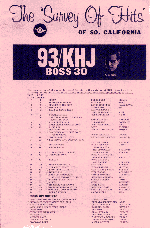
Frank Terry, Gary Mack, KHJ, September 7, 1966 (01:19:30)
Original 1996 RA 3 Exhibit - 'SCOPED (Frank Terry, only) (27:48)
[ORIGINAL DESCRIPTION BY CONTRIBUTOR JEFF MARCH.] Until the spring of 1965, KHJ was one of perhaps nine traditional MOR (middle-of-the-road) stations doing the same old thing in L.A. KHJ's fare included a nightly folk music program hosted by British announcer Michael Jackson (later to gravitate to talk radio at KABC). The debut of KHJ's polished "Boss Radio" format in April 1965 turned L.A. radio on its ears. By the summer of '66, simulcasting KHJ not only had shaken the AM radio establishment but presaged the awakening of FM for youth-oriented formats. While 93/KHJ drive anchors Robert W. Morgan and The Real Don Steele were permitted little adjustments in formatics to express their personas, the other Boss Jocks just hammered out straight-on Boss Radio. Such was the case with Frank Terry, captured on this aircheck taped during KHJ's heyday in September 1966. Frank Terry passed away June 21, 2007, following a ten-year battle with cancer. Gary Mack, who is featured for the last 19 minutes of this recording, went into broadcast management at WSB, Atlanta. [TECHNICAL NOTE: The UNscoped version includes a burst of hiss from an unknown source. It begins at approximately 41:05 and continues until 42:50, during the Art Kevin news. This flaw was in the original recording.]
Return to the Repository
|
| TOP STREAM 32 Kbps
Jimmy O'Neill, KFWB Los Angeles, December 30, 1966 (58:08)
. . .
Playin' more music than I've ever heard on a radio station in my whole life
. . .
[Description by contributor Jeff March]
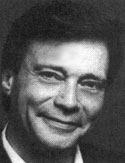 Jimmy O'Neill Note that as of the time of this aircheck KFWB ran news straight up at the top of the hour, abandoning its tradition of running news at :55. KFWB treated its news as an integral part of the programming, with a staff of well-respected local newscasters, including Bill Angel and Beach Rogers, heard here. The station even plugged the contents of upcoming newscasts (you'll hear that about 51 minutes into this aircheck). In contrast to KHJ's tight formatting, KFWB's relaxed approach sounded closer to middle-of-the-road station KMPC. O'Neill, who was host of the ABC television program "Shindig" (1964-66) also was owner of the Pandora's Box teen nightclub on Sunset Boulevard, crowds at which prompted aggressive police enforcement of a 10 p.m. curfew; that prompted protests and confrontations with police in November 1966 that the Buffalo Springfield memorialized in the song "For What It's Worth." O'Neill joined the air staff of KDAY in 1969 for two years, then returned to KRLA in the mid-80s for a couple of stints before retiring from on-air work in 1993. Technical notes: I recorded this aircheck at my parents' home in Van Nuys, on a Wollensak T-1500 half-track mono recorder at 7 1/2 i.p.s. from the line-level audio output of a Sony TR-814 8-transistor radio. This recording was contributed exclusively to REELRADIO. Do not duplicate, trade or sell.
Return to the Repository
|
| TOP STREAM 32 Kbps
Terry Nelson, KROY Sacramento, September 10, 1973 (RESTORED) (34:35)
. . . Sounds like BB got hold of a bad taco, there . . .
This Exhibit 'SCOPED (10:08)With news and a custom vocal effect, full-time DJ Bobby Box opens this short wideband studio aircheck of Terry Nelson on 1240 KROY in September, 1973. Bobby might have preferred to be elsewhere, but as you will hear, Terry sounds very happy in this 11AM hour. In addition to multiple tours of California's Capital City, Terry's warm and personable presentation has also been welcomed at WXLO-FM New York, KFI Los Angeles and KFRC San Francisco. In the 1990's, he also worked on-air at KYMX in Sacramento, before moving a few miles south to Stockton, where we last heard he was working in radio sales.
Return to the Repository
|
| TOP STREAM 32 Kbps
Beau Weaver, KFRC San Francisco November 14, 1973 (RESTORED) (01:02:35)
. . . L. Ron Hubbard - isn't any clearer than Bay Area skies tonight, but like Hubbard, the farther you get, the foggier it becomes . . .
This Exhibit 'SCOPED (11:16)The always enjoyable Beau Weaver is featured with his loose and regrettable behavior on KFRC AM and FM, on Wednesday, November 14, 1973. Recorded from KFRC-FM and 'scoped by contributor Jeff March, it is also presented with music restored for those who savor the Hits of 1973, which with a few "oldies", are well represented in this hi-fi hour. Beau Weaver is a contributor to REELRADIO, and is also the very successful voice behind spokenword.com.
Return to the Repository
|
| TOP STREAM 32 Kbps
Dick Whittington, KGIL San Fernando CA., November 23, 1973 (55:26)
. . . It was called "What Can You Do?" .. and the engineer and I used to kneel down and say a little prayer before we went on . . . [Description by Uncle Ricky] This is the first of a number of airchecks of "Sweet" Dick Whittington, from KGIL, the little station that DID, licensed to San Fernando, California, and included in the Los Angeles, California ratings. On the morning of November 23, 1973, Dick is joined by comedian Jonathan Winters, who talks about his beginnings in radio in Dayton, Ohio, and his art gallery opening. Sure, it's not Top 40 radio, but it is something very special.
Return to the Repository
|
|
Dusty Morgan, K108 Sacramento, 9-18-1974 (21:00)
After abandoning an oldies format, KXOA-FM switched to a Top 40 format in 1974 in the hope of challenging AM Top 40 leaders KROY and KNDE. In an era in which stations proudly announced their call letters, KXOA-FM called itself K-108. Although KXOA would again change format to a very successful "mellow rock" approach within two years, Dusty Morgan remained with the station into the 90's. |
|
TOP STREAM 32.0 Kbps (16Khz)
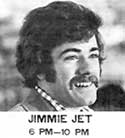
Jimmy Jet, KYA San Francisco, 1974 (15:05)
. . . Jimmy Jet, flyin' high in the Bay Area Sky . . .
Russ "The Moose" Syracuse was the first pilot of Flight 1260, but apparently, 1974 was the "Jet Age". It's almost like Boss Radio didn't happen, and competitor KFRC didn't exist. It's "People Power KYA" and Pilot Jimmy is using drops and bits like it's 1959 - This is truly one of the most unusual 1974 airchecks we've ever heard. We even have a high school kid reporting the Top Five, and a produced intro for a musical feature called Cable Car Cluster. Most jocks (and Program Directors) had forgotten how to do this kind of Top 40 radio in 1974. And yet, here it was. And who was Jimmy Jet, and where is he today? |
|
TOP STREAM 32Kbps (10Khz)
Dr. Don Rose, KFRC San Francisco, January 7, 1975 (RESTORED) (37:51)
This Exhibit 'SCOPED (17:23) . . . Words flail me . . . [Contributed by Jeff March, Description & Restored by Uncle Ricky] The late Dr. Don Rose brought his best game to San Francisco's KFRC every morning for over a decade. On the day before Elvis Presley's 40th birthday (January 7, 1975), newsman Jack Hines gets in on the fun, too, in addition to delivering a precision 10-minute morning newscast. Bobby Ocean is the voice for the KFRC Man With The Golden Gun promotion, and Tom Campbell is selling Koss Pro-4AA headphones! |
TOP STREAM 20.7 Kbps (10Khz)
. . . local drizzlies . . .
After working at oldies-formatted KRTH in Los Angeles for a year or so, former KROY morning man Dave Williams returned to his native Sacramento to become program director at KNDE (Rock KANDIE), which began amassing an air staff composed of former KROY jocks, including Keith Richards and Steve Moore. On this jubilant day, program director Williams had just received an Arbitron report that showed KNDE (1470, 5KW, directional) surpassing KROY (1240, 1KW day, 250w night) for the first time. Although KNDE and KROY soon both lost ground that they never regained, Keith Richards and Dave Williams enjoyed this last hurrah of AM Top 40 radio in Sacramento, recorded on January 10, 1975 from 2:30 - 3:30 PM. [Uncle Ricky adds: Dave Williams was number one for 19 years in Sacramento, California on the KFBK Morning News. In November, 2000, Williams moved south and has continued to work in the Los Angeles market.] |
|
TOP STREAM 32.0 Kbps (10Khz)
Charlie Tuna, KIIS-FM, August 23, 1976 (33:35)
. . . sitting here talking with my plants . . . [Description by Uncle Ricky, contributed by Jeff March] From August 23, 1976: Lori Lerner leads with a newscast that features an ABC report, and Charlie Tuna plays a short selection of super-burnt Young Adult Hits Of The Seventies on KIIS AM/FM (Kay-Double-Eye-Ess). The station was in stereo, but this recording was made with a monaural receiver, allowing us to hear some of the slightly out-of-alignment phase error so common with cart-based formats of the day. We don't know what The Edgar Winter Group is doing in the station promo at the end of this exhibit, but bring an extra cup of coffee for the Neil Diamond ten-minute collage. Confounding the entire effort are a few forgettable jingles of unknown origin. |
|
TOP STREAM 32Kbps (10Khz)
Al Lohman and Roger Barkley, KFI Los Angeles, November 16, 1976 (39:11)
This Exhibit 'SCOPED (30:58)[DESCRIPTION BY UNCLE RICKY, CONTRIBUTED BY JEFF MARCH] I distinctly saw a hickie on Mrs. Hoiser... Can I buy your vote? Kenny Rogers performs a KFI jingle, and Al Lohman And Roger Barkley are the exceptionally brilliant and entertaining long-time Los Angeles morning team. Mr. Hoiser doesn't understand that Mrs. Hoiser has a hickie - he thinks she's playing hockey. Verne Williams and Mike Parker are featured with news. Bruce Wayne is K-F-Eye In The Sky. There's a KFI Editorial, with a "fairness doctrine" solicitation for opposing views. Following a spot for TV's Eyewitness News, Al and Roger remark that "if it's on the radio, it's very often a lie, but if it's in the newspaper, it's true..." There's commentary about Jimmy Carter and his new job. Strange jingles, but the music was for young adults. The format was not the slenderized presentation yet to come. |
|
TOP STREAM 32Kbps (10Khz)
The Real Don Steele, KTNQ Los Angeles, February 24, 1977 (58:03)
This Exhibit 'SCOPED (17:36)... Good Gravy! Mercy, Mr. Percy! Lawdy Miss Clawdy! Devil with a blue dress on! ... [DESCRIPTION BY UNCLE RICKY, CONTRIBUTED BY JEFF MARCH]
Tina Delgado Is Alive on KTNQ (The New 10-Q) starring the inimitable Real Don Steele and his energetic performance with everything you need to boogie. This exhibit features the 4-5PM hour, recorded on Thursday, February 24, 1977. Boyd R. Britton is featured with news. The big story is anger over the L.A. school integration plan. |
This Exhibit 'SCOPED (22:08) - in the original RA 3.0 format. . . A recent survey indicates an active sex life may be one key to living a longer and healthier life. Lack of sex simply makes life seem longer . . . There was no other like Dr. Don Rose. A mainstay in Philadelphia, Dr. Don brought his high-energy antics to San Francisco's KFRC (610 kHz, 5 kw fulltime) in the mid '70s. Dr. Don rapid-fired one-liners like a gatling gun, launching barrages of material that others would have doled out over entire shifts. I interviewed Dr. Don for a magazine article in 1979 and found him to be gracious, warm, self-effacing, and as humorous off-air as he was on. Don Rose passed away March 29, 2005. |
|
TOP STREAM 32Kbps (10Khz)
Glynn Shannon, KGW Portland, OR. June 6, 1979 (34:59)
... more fun than sippping salad through a straw ...
This Exhibit 'SCOPED (08:11)[DESCRIPTION BY UNCLE RICKY, CONTRIBUTED BY JEFF MARCH] This aircheck comes out of the gate like a winner. Glynn Shannon is ready to roll, he sounds friendly and happy, the TM jingles are great and the first two records are right on target for a midday 25-49 audience. And then, inexplicably, the station changes to the iPod format, right before our very ears. KGW, classic call letters going back to 1922, are tossed aside in favor of the jukebox concept. So, Super 62 stumbles a few minutes into this recording and never quite gets up again. KGW had better days, for sure, but at least 620 Khz still had the call letters in 1979. In 2008, it's KPOJ, a progressive talk format. |
|
TOP STREAM 32Kbps (10Khz) Rick Shannon, KJRB Spokane, WA. June 8, 1979 (46:02)
This Exhibit 'SCOPED (28:57)... I was just in the bathroom, writing down some braille graffitti, in case Stevie Wonder should ever visit the station ... [DESCRIPTION BY UNCLE RICKY, CONTRIBUTED BY JEFF MARCH] You Can Feel It All Over! Over 60% of this 46 minutes of morning guy Rick Shannon on Spokane's KJRB is news, spots, features or Rick Shannon. With only five songs in 3 quarter-hours, this exhibit clearly demonstrates obese commercial sets in 1979. Otherwise, the presentation is professional, clean, and a lot more complicated than a "liner card" format. Ron Karolis has the news and Tom Hutler is the sports guy. There are jingles and ongoing bits and promotions, too. |
|
TOP STREAM 32Kbps (10Khz) Gary Lockwood, KJR Seattle WA. June 9, 1979 (29:27)
This Exhibit 'SCOPED (10:30). . . Dance the night away with the best disco music, from 9 to midnight . . . [DESCRIPTION BY UNCLE RICKY, CONTRIBUTED BY JEFF MARCH] Gary Lockwood is ballsy and sensibly sassy on KJR (950 Khz) on Saturday, June 9, 1979. The station's (nice!) jingles (JAM?) have a beat reflective of 1979, and Disco Saturday Night is coming up. But the playlist in this half-hour, recorded from 3:48 - 4:18 PM Pacific Time, tempts triple torture with three male ballads, each with piano. Ugly indeed, but the record out of the top of the hour has to be in the Top 100 of the all-time worst records to play out of a hot top-of-hour ID. The station had it goin' on otherwise. The Seattle Entertainment Calendar is casually presented without fanfare, very hip. There are several upcoming events and some very tight and dense breaks, not only for the station, but for the sponsors. The 'scoped version demonstrates the good sounding stopsets which are enjoyable, not only for the production value, but for the local content. It sounds as though the local Seattle club scene was rockin'! |
Additional Exhibits in The Jeff March Collection