REEL TOP 40 RADIO REPOSITORY

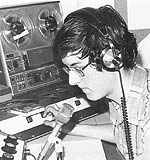
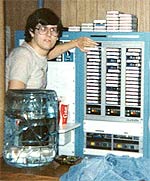
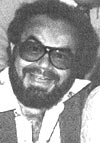
To completely rip off the infamous Ted Baxter biography introduction from "The Mary Tyler Moore Show" — it all started at a 130-watt radio station in Ojai (Ventura County), California. That was where, during the summer of 1973, between my junior and senior years of high school, I began working for KOVA, with its mix of beautiful music instrumentals, vocal standards, big bands, and (at night) classical music. I might not have been "playing the hits" but it was radio, and this 16-year-old really wanted to be on the air! Fast forward to 1977: 50,000 watt Top-40 powerhouse KACY was buying KPMJ-FM and one of the latter's announcers had decided not to stay on until the sale. Not knowing what was going to happen, but seeing an opportunity, I moved to KPMJ, helped launch a beautiful music format there — and got tossed out the door with the rest of the airstaff six weeks after we moved into our new studios at the KACY building. But unemployment was not to last long, because crosstown KAAP-AM/FM had just started simulcasting. The mom-and-pop owners were horrified, once the simulcast began, at how terrible it sounded (apparently they had never really listened to their own FM). But they had a solution: Program a contemporary station for 20-to-40 year olds, and hire someone from that demographic as the PD. My involuntary exit of KACY was their motivation to implement that solution, and after about three minutes spent convincing me to come aboard, I found myself in my first PD gig, at the ripe old age of 22! We ended up being the first true adult contemporary station in the Ventura-Oxnard market, reaching 5th place among 18-34 listeners in the first book — with no outside promotion, yet. KAAP was sold in 1981 and I moved on to the APD slot at KBBY, which somehow included an airshift on country KBBQ. It was out to the Antelope Valley a few years later for afternoon drive at KDOL (where I also voicetracked middays at co-owned KTPI) before returning to Ventura for middays at KMYX, which had morphed from the KOVA that I had begun at a baker's dozen years previous to an Urban Contemporary format. All of this led up to the part of my on-air career I loved the most. In 1987, Y-97 in Santa Barbara had an opening for a full-time weekend/utility/production person and I was visiting with then-PD Steve Smith just when he was looking to fill that slot. Steve had a great instinct for what that market needed and his hybrid Urban/New Wave format was #1 for several books in a row; when he left for greener pastures a year later, I got plugged into his afternoon drive shift "temporarily" only to have new PD Mike Schaefer decide to keep me there. The next book, I had an unheard-of 23 share (12+), only to get blown out by a GM who didn't understand why I didn't drop everything when an advertiser called me on the request line, on the 4th of July, wanting his copy changed. (The station went completely into the dumpster the next book.) I somehow managed to get in with Los Angeles market rimshots KGIL and KWNK, coordinating the latter's switch from satellite music to talk in 1989, before returning one last time to KMYX, which had then gone "album-oriented country". I did morning drive as well as APD/MD duties until it was sold at the end of that year. Since then, I've done my fair share of consulting — the historic occupation of burned-out programmers who had one too many gig that included on-air work — and have put out a lot of fires without any fanfare or public credit. But I'd still put on my PD stripes again if the right opportunity came up (don't we all say that?). The Repository thanks KM Richards for sharing! |

 TOP STREAM 32 Kbps (10 Khz)
 Gary Shannon, KJR Seattle, December 31, 1969
(31:46)
Gary Shannon, KJR Seattle, December 31, 1969
(31:46)
. . . 1970 will be here in eighteen minutes, or seventeen and a half minutes, I'm not sure . . . [Description by contributor KM Richards] Top-40 long had the tradition of counting down the top songs of the year as midnight approached on New Year's Eve. At KJR in Seattle in 1969, Gary Shannon did the honors, and this 'check includes the top ten songs from that countdown. By the mid-70's, Shannon moved to Atlanta's "Quixie", WQXI, where he took on the airname Rhett Walker - possibly a tribute to his former crosstown Seattle competitor KOL's Rhett Hamilton Walker. [A 'scoped version of this aircheck was published by REELRADIO on March 3, 2002 in The David Critchfield Collection.] |
|
TOP STREAM 32 Kbps (10 Khz)
Jimi Fox, KFMB-FM B-100 San Diego, Summer 1975
(01:00:08)
 This Exhibit 'SCOPED (16:04)
. . . oh, you can't cue it up with the mike on, can you? . . . [Description by contributor KM Richards]
Rich, in one of of his online columns, wrote that the "B-100" imaging came about somewhat by accident, because the station owners refused to allow a call letter change from KFMB-FM to go along with the new format. Hence, the quasi-hidden legal ID of "KFM-BFM, San Diego" at the top of the hour. Fox left B-100 a little more than a year after this aircheck to program KTNQ "Ten-Q" in Los Angeles, but returned to San Diego in 1977 as PD of KCBQ. |
 TOP STREAM 96 Kbps (15 Khz)
Jim Carson, Drake-Chenault Best of 1979 Top Ten Countdown (52:20)
This Exhibit 'SCOPED (06:35)
TOP STREAM 96 Kbps (15 Khz)
Jim Carson, Drake-Chenault Best of 1979 Top Ten Countdown (52:20)
This Exhibit 'SCOPED (06:35). . . Here's an act that made history in 1979 by becoming the first black entertainment duo to perform on mainland China . . . [Description by contributor KM Richards] During its big years as a syndication company, Drake-Chenault would produce "Best of" reels for its stations to play over New Years. In 1979, they added a new twist — no doubt due to the fact that they had launched The Weekly Top 30 in July of that year — which was a countdown of the top ten contemporary sounds, to be played in the 11:00 PM hour as a lead up to "Auld Lang Syne" at midnight. With Mark Elliott tied up hosting WT30, this was generically hosted by Jim Carson, long-time Los Angeles air personality (at the time, working at KIQQ) and the voice of of D-C's "Contempo 300" and "XT-40" current reels. Since this show was provided to client stations of both formats, the song list was modified somewhat from what Billboard had determined were the top songs of the year, although somehow "My Sharona" by The Knack managed to sneak in, making for a rather odd deviation for those "Contempo 300" stations that ran this special. As far as I know, 1979 was the only year that Drake-Chenault produced a countdown reel, and they never did one for any of the other formats. |
|
TOP STREAM 96 Kbps (15 Khz)
Mark Elliot, Drake-Chenault Weekly Top 30, September 19, 1981 (Hour 1) (49:17) . . . there's a certain sound that a jingle singer has . . . [Description by contributor KM Richards] In the early 1980s, it seems everyone was in the countdown show business. Drake-Chenault's entry was The Weekly Top 30, hosted by their perennial "everything" announcer, Mark Elliott. Since Casey Kasem had the Billboard charts locked down, D-C had to settle for its own "exclusive countdown computer" calculation of the hits. A check of this first hour of the show for the week ending September 19, 1981 shows that they were never more than three positions away from any song's position on the Hot 100, though — provided it was an upward mover. Not content to just count down the hits, D-C managed to work in parts of its other syndicated programming, such as the feature that started the fifth segment of this hour, which appears to have been taken directly from their "Golden Years" specials. The Weekly Top 30 lasted only a few more months after this — until January, 1982, after which Mark Elliott was a frequent guest host on the show that started the whole countdown craze, American Top 40. |
|
TOP STREAM 64 Kbps (15 Khz STEREO)
Soupy Sales Moldy Oldies, April 12-13, 1986 Pt. 1 (54:51)
Soupy Sales Moldy Oldies, April 12-13, 1986 Pt. 2 (51:26)
. . . The following program is brought to you in living color, on NBC . . . [Description by Uncle Ricky, contributed by KM Richards] Soupy Sales Moldy Oldies Show was syndicated by NBC Radio Entertainment and distributed on vinyl for an unknown period of time beginning in April, 1986. This was the second show of the series, intended for broadcast April 12-13. This show included commercials, and participating stations were expected to include all the commercials on the disc. Some are included here. This show took a lot of work and apparently included a band and live audience. Soupy Sales passed away on October 22, 2009. For the week including January 8, 2010, the debut of these broadcast-quality exhibits on REELRADIO is in observance of what would have been Soupy's 84th birthday. He would have been 60 when this show was recorded. The show was like "Vaudeville Oldies" with many recurring phone calls and door-knocking visitors — only the jokes were older than the music. Ray D'Ariano was the "announcer" for this show, and he was also "straight man" on Soupy's WNBC radio show. He took over the time slot at WNBC after Soupy left. |
TOP STREAM 44 Kbps (10 Khz MONO)
ABC-FM Listen Closely, Mel & Noel Blanc May 26, 1987 (14:57)

. . . Half a century of Mel Blanc . . . 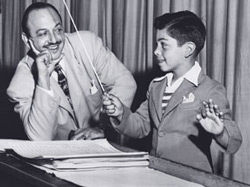 Young Mel & Noel [Description by Uncle Ricky, contributed by KM Richards] Mel Blanc and his son Noel Blanc were showcased on Listen Closely, an ABC-FM Public Affairs program broadcast on KMYX/Ojai, CA. on May 26, 1987. The feature commemorates the fifty years that Mel Blanc created unforgettable voices for some of America's most memorable and original cartoons. Mel and Noel talk about growing up and working together, Mel's near-fatal automobile accident, the doctor who got him talking again, school days and Nancy Sinatra. Mel Blanc passed away about two years later, on July 10, 1989. |
|
TOP STREAM 64 Kbps (13 Khz STEREO)
J.J. Jackson, KEDG Glendale-Los Angeles, May 12, 1989
. . . I have never, ever, seen such intelligent and caring listeners in my whole life. . . . [Description by KM Richards] "Video Killed the Radio Star," if we are to believe The Buggles, but in one case Video Made the Radio Star Bigger. That star was the late J.J. Jackson who, while never a top-40 air personality, is likely as well-known as any who were. 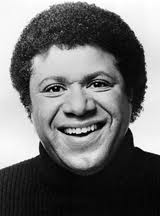 J.J. Jackson After coming to prominence at legendary AOR station WBCN in Boston, J.J. moved to Los Angeles in 1971 to be part of the airstaff of ABC-owned "Rock 'n Stereo" KLOS. Ten years later, he was one of the original five "VJs" on MTV: Music Television. Upon returning to L.A. post-MTV, he surfaced at modern rock pioneer KROQ before becoming the program director of alternative rock KEDG, "The Edge". These recordings cover the final two hours of The Edge on the evening of May 12, 1989, with Jackson at the controls. It includes phone calls from Melissa Etheridge, whose career was just taking off; blues legend Willie Dixon; KROQ DJs Dusty Street and Freddy Snakeskin; and Brian Setzer of Stray Cats. There is also a brief interplay between J.J. and legendary Los Angeles AOR personality Jim Ladd at the outset, and a few of the other Edge personalities — "Dangerous" Deon, John Logic, and Cynthia Fox — turn up briefly during the course of this finale. KEDG returned to the air six hours later as soft A/C KLIT ("K-Lite"), changed formats in 1994 to Adult Album Alternative KSCA and was then sold to Hispanic Broadcasting Company (today's Univision Radio), which flipped it to Spanish-language "La Nueva" in 1997. Jackson shopped the Edge format around the market for several months then returned briefly to KLOS and KROQ, and did afternoon drive at smooth jazz KTWV "The Wave" in 2003. He also hosted "The Beatle Years" for Westwood One starting in 1995, and had recorded voicetracks for that program only a few days prior to his death. J.J. Jackson died March 17, 2004 at age 62, of a heart attack. Coverage of his memorial service is at the LARadio.com website. | ||||||
|
TOP STREAM 64 Kbps (10 Khz)
The KHJ Story, Starring Bill Drake (23:30)
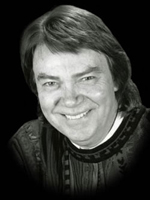 Bill Drake [Description by Uncle Ricky for contributor KM Richards] Over the years, REELRADIO has hosted thousands of comments about The Drake Format. If nothing else, this exhibit settles once and for all where jingles should be placed. Right? This program, produced by KRTH Imaging Director Keith Smith opens with flashes of classic KHJ airchecks and production, mixing into comments from Robert W. Morgan at the 1990 KHJ Silver Anniversary Dinner. It's a slick introduction to the excellence that follows. We are treated to KRTH Morning Host Gary Bryan on the occasion of K-Earth's 35th Anniversary in October, 2007, and a casual conversation with Bill Drake. Bill Drake passed away on November 29, 2008. This CD was distributed at his Memorial Service on December 3, 2008. Drake gave his last interview on August 29, 2008. |
The KM Richards Collection has been part of REELRADIO since May 10, 2009.
Reel Top 40 Radio Repository ©1996-2014 REELRADIO Inc.